

The American Dream (Part 3)
The story of “Harry” Kawabe, a penniless immigrant who beat the odds.

Seattle was a north-facing city. It was the hub for the booming salmon business, centered in the Alaska fisheries. A busy shipping route connected Seattle with ports up the Northwest coast. Japanese immigrants worked on the ships and in the canneries. Immigrants might be hired in Seattle, and move up the west coast to a cannery in Bristol Bay, Prince William Sound, the Alaska Peninsula, or the Columbia River. Japanese workers often served as skilled “slimers,” (who cleaned the fish before they were filleted and canned), or as machinists or supervisors, while Chinese crews handled butchering and canning lines. Sōtarō wasn’t the only Japanese immigrant to look for opportunities further north. But his eyes were not on fish. He was thinking about gold.
Over the past decade, tens of thousands of prospectors had flooded into the Alaskan gold fields in Klondike, Nome, and Fairbanks. Sōtarō set his sights on profiting from the booming industry – if not as a prospector himself, then in one of the industries servicing the influx. Kikuzō and his wife tried to talk Sōtarō out of his plan. He was still very young, and the gold fields were notoriously fickle, full of tricksters and frauds. But in April, 1909, still only 19 years old, Sōtarō quit his job in Seattle, left some belongings for safekeeping with Kikuzō’s family, and boarded a steamer bound for Alaska.
Sōtarō disembarked in Port Graham on the Kenai Peninsula, and found himself a job working as cook in a shipbuilding company. It was here that he was given the English name “Harry” by his boss. The name stuck, and for the rest of his life he was Harry Kawabe. The pay was excellent - $60 a month – but Harry was chagrined to learn that white cooks in the same position made more than twice as much. In November, Harry moved to Cordova, a newly-built port town east of the Kenai Peninsula on Prince William Sound, which had recently been opened to service the rich copper mines located up the Copper River. Once again, he got work as a cook.
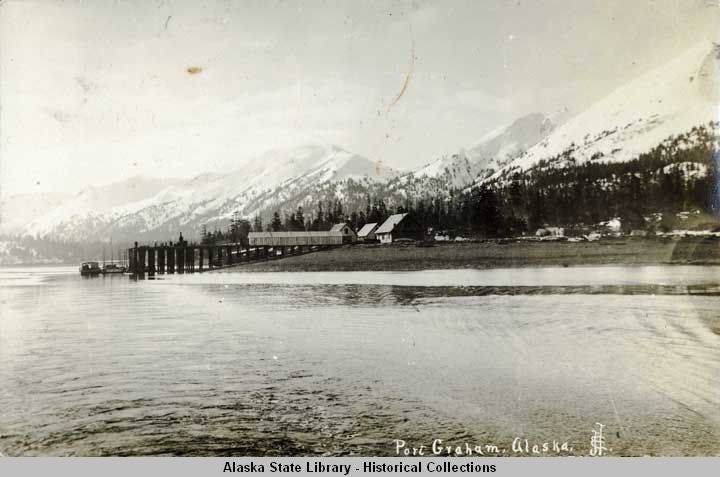
Port Graham, Alaska, c. 1910
Credit: Alaska's Digital Archives
Ever the thrifty entrepreneur, Harry saved his wages and, while continuing to work as a cook, he opened a series of small businesses which he operated on the side: a bath house, a pool hall and card room, and a laundry service. He aimed to serve the small community of miners coming and going from the port, but none of his businesses prospered. Perhaps the traffic was too sparse.
After a year or two in Cordova, Harry was hired as a cook by the recently-opened Copper River and Northwest Railway Company, which ran 200 miles up to the copper mines in Kennecott. Harry’s new job him brought him into direct contact with the mines that had brought him to Alaska. He saw the traffic on the railway as gold finds in the Chisana mountains brought in a new influx of prospectors. He knew there was money to be made.
In 1913, after six years working in the kitchens, Harry quit his job to try his luck once again as an independent businessman. He opened a small store in Cordova, selling supplies to the miners moving back and forth to the mines. However, the Chisana gold strikes quickly fizzled, and Harry’s business once again went broke.
Harry, now 23 years old, returned to working for the railway for another year or so. But his restless desire to make his own fortune led him in 1915 to Seward, a developing port of 300 or so residents on the Kenai peninsula. Seward was the terminus of the newly opened Alaskan Railroad, which connected to the Iditarod gold fields.
Harry was to remain in Seward for the next 27 years.
The railway brought in an itinerant population of miners, fur trappers, and others going back and forth on the railway. It was these travelers in particular whom Harry particularly hoped to target – ideally, sharing in some of their mining wealth. The town did indeed prosper. Its permanent population roughly doubled to 652 by 1920 and was close to 1,000 by the 1930s. Those locals who weren’t catering to the itinerant miners were in the dairy, fishery, or timber businesses.
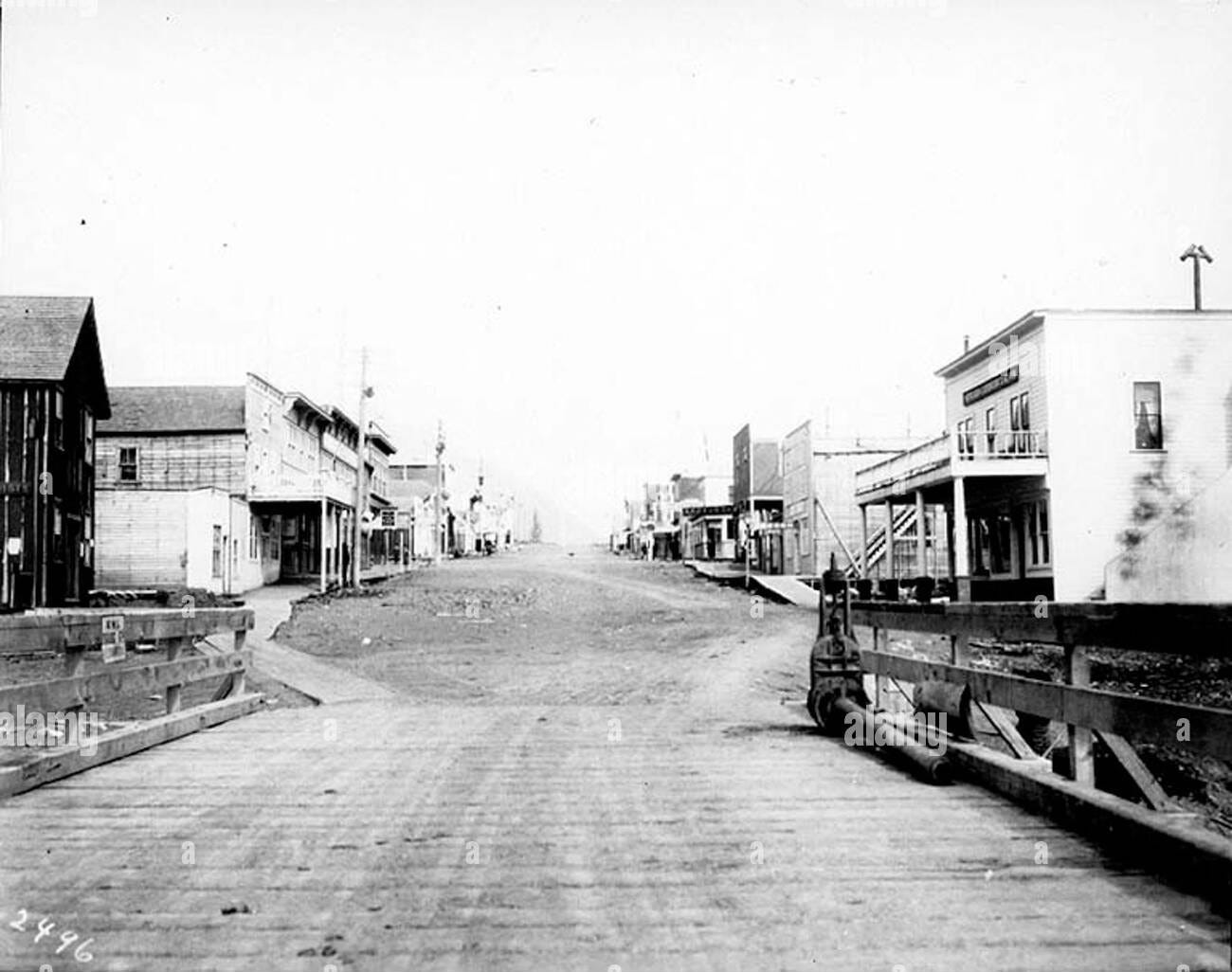
Fourth Avenue in Seward, Alaska, c. 1907
Credit: Historic Collection
Once arrived in Seward, Harry took a job in the Seward Steam Laundry. It was one of the few businesses that would take Asian workers. The following year Harry and a white partner named Badger scraped up the funds to buy out the laundry’s owners. By now Harry had a significant amount of experience as a business owner, and that perhaps helped him avoid the mistakes of the past. The laundry prospered under his management, to the point that after five year, in 1921, he could buy out his partner and become sole owner of the business.
The Seward Steam Laundry occupied the ground floor of a substantial two-story building, with residential quarters on the second floor. As the name suggests, the service used steam-powered washing machines using hot water from the same boilers. The equipment allowed them to operate on a large scale, washing bed-linens and tablecloths for hotels and restaurants, for example. Harry employed two white women, Miss Lien and Miss Hutton, as washerwomen, and eight other employees, mostly Japanese. It was a remarkable reversal after his decade as a lowly cook and houseboy.
Over time, Harry’s business established a reputation for honesty and reliability – probably scarce commodities on the Alaska seaboard – and it gained prestigious and profitable customers such as the US Army, the Pacific Steamship Company, the Alaska Railroad Company, and several hospitals.
Harry or one of his employees went down to the docks to meet every ship that pulled into Seward port. He would take clean laundry for the ship and receive their soiled laundry for cleaning and delivery on their next visit.
By the 1920s, Kawabe’s laundry was reputed to be the biggest in Alaska.
On much of the west coast, Japanese immigrants were prevented from owning property by discriminatory “Alien Land” laws. Alaska was not a state but a territory, and this quirk of territorial law gave him a foundation on which to build. Here, he could buy land and hold it in his own name, a freedom denied Japanese immigrants in many of the contiguous states.
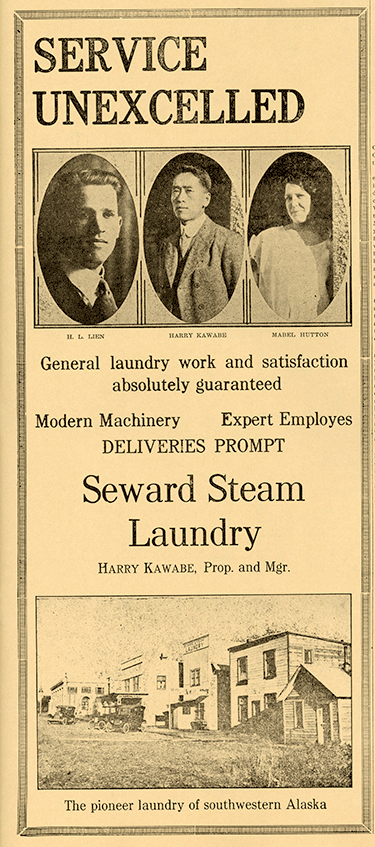
An advertisement for Kawabe’s laundry business, Seward Steam Laundry
Credit: University of Washington Magazine
By the 1920s, Harry Kawabe was a familiar figure on Seward’s streets. He was not tall, but he carried himself with dignity, his English accented but serviceable. He wore practical suits and a felt hat, often walking briskly from one of his enterprises to another. His businesses employed townsfolk; his rentals housed families. In a community where everyone knew everyone, Harry’s reputation was gold. “Service unexcelled,” one local later remembered - a phrase that captured his ethic.
In 1923, now 33 years old, Harry returned for the first time to his hometown in Japan. While he was there, his parents arranged a marriage for him, to Suzuki Toshiko. Toshiko accompanied him back to Alaska, but she suffered from chronic illness and returned several times to Japan to recover under medical treatment there. She died in Japan in 1930, and, the following year, Harry remarried, this time to Kawano Tomo (it’s not clear where, or how, they met).
Tomo and Harry remained childless, but during the course of a decade in Seward, they took in and helped educate more than a dozen needy children, Native American and white. This was the first of many acts of philanthropy that were to occupy more and more of Harry’s time as he got older.
Harry’s business continued to prosper throughout the 1920s and 1930s, and as he accumulated capital, he continued to expand. By the end of the 1930s, in addition to the laundry, he owned the Bank of Seward, Kawabe’s Gift Shop, Alaska Furs, the Seward Hardware Company, the Place Hotel and Grill, the Moose Bar and Liquor Store, the Marathon Café, the Seward Grill, and the Miller barber shop, as well as properties and apartment buildings throughout Seward. He also invested in a gold mining operation at Moose Pass, and a lumber business. He was among the largest property and business owners in Seward, and one the wealthiest Japanese immigrants in the entire United States.
This story is part of a series called “Japantown Stories”, about the adventurous spirits who made the journey from Japan to America around the turn of the twentieth century. If you like what you’re reading and want to see more of this work, please subscribe!
For Part 4:
