

The American Dream (Part 4)
The story of “Harry” Kawabe, a penniless immigrant who beat the odds.

In the 1920s and 1930s, Harry Kawabe built one of the biggest business enterprises in Seward and became one of the wealthiest Japanese immigrants in North America. The secrets to his success: hard work, determination, the flexibility to rebound after a setback, and a willingness to take risks.
But in the 1940s, Harry suffered a series of disastrous setbacks that cost him a large part of his business.
In November 1941 and again a few months later, Seward suffered two large fires that between them destroyed more than half the homes in Seward, included several of Harry’s properties.
That was nothing, however, compared to the devastating blow suffered by Harry and all the Japanese community in December 1941. The Japanese attack on Pearl Harbor brought a swift and fierce reaction from the Alaskan authorities. Japanese immigrants were arrested as enemy aliens and incarcerated.
For Harry, the knock on the door came late one evening just a few days after the Pearl Harbor attach. Together with four of his employees, he was transported to Fort Richardson, the military headquarters for the region. He had no time to collect his belongings, nor to put his affairs in order. His wife Tomo was arrested two weeks later and interned at another location. Most of the Fort Richardson internees were prominent members of the Japanese American community. At least six of them owned laundry businesses.
The internees were housed in makeshift accommodation in the main barracks. In the bitter cold of the short winter days, they were put to work building their own prison: a roughly 10-acre site in a corner of the camp, surrounded by barbed wire and with searchlight-mounted guard towers at all four corners. They were housed under canvas, in sixteen-foot-square tents that were supposedly winterized, but that must have been bitterly cold in the harsh Alaskan winter.
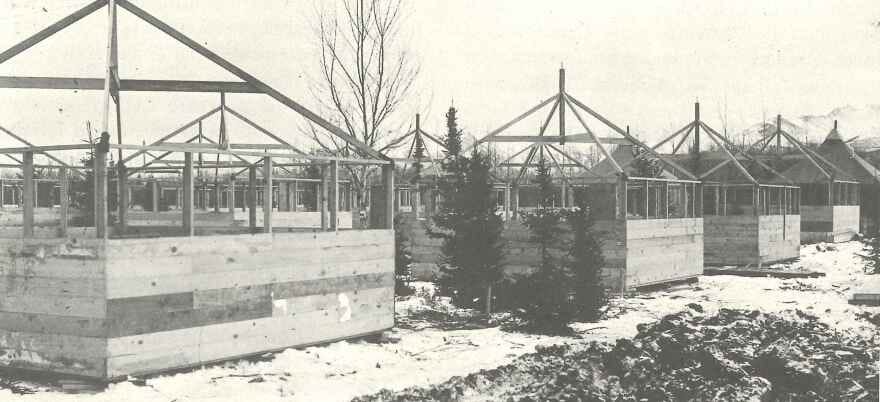
Camp construction in Fort Richardson, Alaska, 1942
Credit: Alaska Public Media
At some point in 1942, Harry, Tomo, and all the other Japanese immigrants in Alaska, together with their American-born children, were deported to military camps in the contiguous states. Harry and Tomo were sent to Fort Sam Houston in Texas, and then they were separated, and Harry was sent to a men-only military camp at Lordsburg, New Mexico. Tomo, like most Japanese internees, was placed in a facility administered by the War Relocation Authority. By contrast, Lordsburg was a purpose-built military prisoner-of-war camp. Later in the war, it housed as many as four thousand German and Italian prisoners of war.
Many of the 1,500 Japanese internees in the camp were influential citizens in their home communities: prominent businessmen like Harry, Buddhist priests, and journalists. They were treated as prisoners of war and required to wear uniforms with “POW” in large letters on their backs. The internees were divided into groups of 250, with each group allotted eight residential barrack buildings as well as a mess hall, latrines, and a recreation building. The thirty men in each barrack had to sleep in cots without any partition or personal privacy. One internee later recalled that on their arrival his group only had one working faucet for 250 men, with the ground still unleveled and strewn with trash. The desert winds blew the fine dust from the construction site into the internees’ noses and mouths, forcing them to cover their faces when they went outside.
In October, 1942, the first actual prisoners of war arrived at the Lordsburg camp. They were a group of fifty Japanese, the crew of a submarine sunk at the battle of Midway. They were housed indiscriminately with the Japanese immigrant internees. Subsequently, twenty American soldiers who had been arrested for a variety of crimes were co-housed at Lordsburg, as well as a group of fifteen Japanese Americans from another camp who had failed the so-called “loyalty questionnaire.”
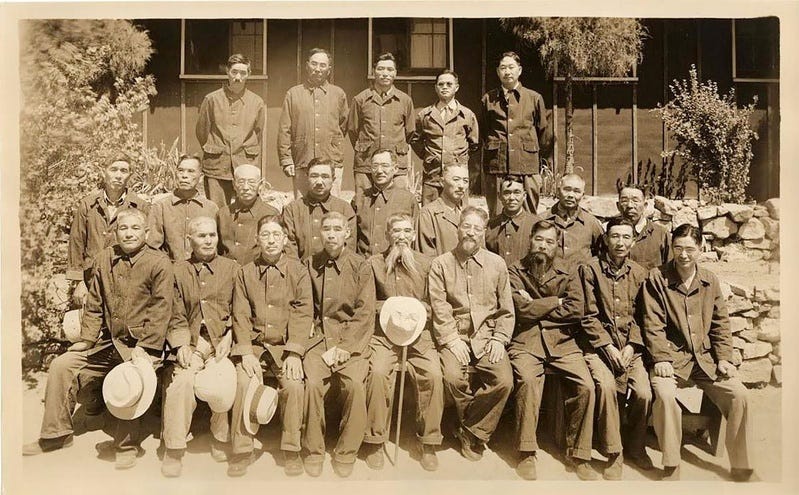
A group of internees at Lordsburg, New Mexico, c. 1942
Credit: Discover Nikkei
Although most of the men at Lordsburg were middle-aged or older, they were required to do physical labor in harsh conditions, including construction of the camp itself. Characteristically, Harry was elected “mayor” of his section of the camp.
In the summer of 1942, the camp commander, Clyde Lundy, ordered the internees to do heavy manual labor in the punishing desert heat. Fearing for the internees’ health and even their lives, three of the mayors, including Harry, protested to Lundy and urged the internees to refuse the order to work.
Enraged, Lundy put the mayors and their striking fellow-internees under house arrest, confined to their stifling barracks except to use the latrines. The grounds were patrolled by armed guards.
Undeterred, Harry wrote to the Spanish embassy in Washington (Spain was a neutral country) asking them to send a team to investigate.
A few weeks later, two elderly inmates, lagging behind their group, were shot and killed by a guard who claimed they had tried to escape – a clear contravention of the Geneva convention even for a prisoner of war, let alone a civilian internee.
Finally, in April, 1943, Harry was allowed to join Tomo in the Crystal City Family Internment Camp in Crystal City, Texas. Once again, Harry was appointed as a spokesman for the internees.
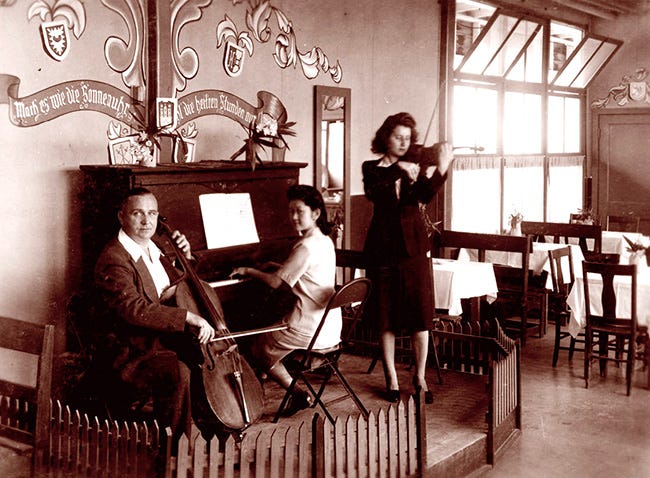
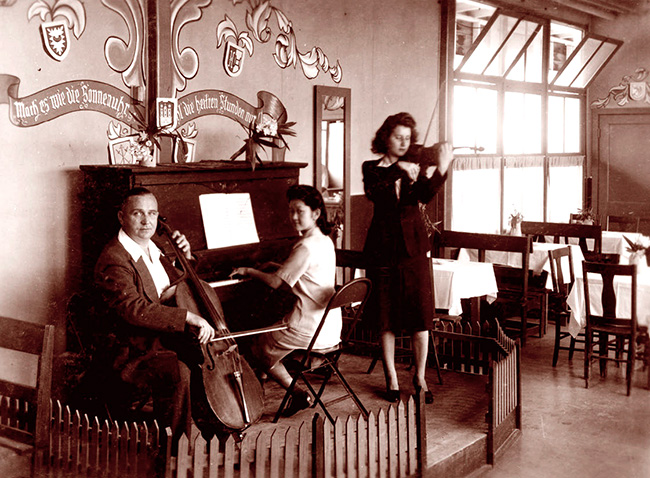
German American and Japanese American internees performing at a German beer hall, Crystal City. Source: Densho
Crystal City had originally been built as part of a New Deal program to house migrant farm workers, mostly Mexicans, who had been displaced by the Depression and Dust Bowl. During the war, it housed both Japanese and German internees, who lived in separate facilities within the camp. The Japanese contingent included many American-born children. In the camp, they were treated as enemy aliens together with their parents. Crystal City also housed a large group of South American internees of Japanese descent, whose governments had allowed them to be kidnapped and brought to the US by the American military.
However, the camp was far more accommodating than the Lordsburg POW camp. It had three schools, a citrus orchard, and extensive recreational facilities including basketball and tennis courts, and a swimming pool. It was here that Harry and Tomo lived through the last years of the war.
This story is part of a series called “Japantown Stories”, about the adventurous spirits who made the journey from Japan to America around the turn of the twentieth century. If you like what you’re reading and want to see more of this work, please subscribe!