

The American Dream (Part 2)
The story of “Harry” Kawabe, a penniless immigrant who beat the odds.

The Shinano-maru docked in Seattle on September 20, 1906. Sōtarō disembarked with the other passengers, and waited in line to be interviewed by the immigration officers. After a medical checkup and some form-filling, Sōtarō was released onto the pier, where he was met by a young man from Maihara, Ueminami Kikuzō. Kikuzō was five years older than Sōtarō. By this time, he had married and had a family in Seattle. Kikuzō and Sōtarō’s home town of Maihara had been sending a steady stream of emigrants to the West Coast, more to Vancouver than to Seattle. Powell Street in Vancouver had a block known as “Kōtō village”, named for the region east of Lake Biwa where Sōtarō had lived.
Who knows what dreams were in Sōtarō’s head as he walked with his fellow townsman through the streets of Seattle? Lumber mills perfumed the air with the sharp scent of resin, while sawdust floated in the afternoon sunshine. Seattle by this time had around 4,000 Japanese immigrants – the largest minority group in the city. Most lived in the Nihonmachi (Japan Town) district, centered on Jackson, Main, and King Streets. Kikuzō’s family lived on Broadway, at the edge of Nihonmachi. Many immigrants without contacts in the city lived in small rooms in the forty or so boarding hotels on Jackson or Main Street. The Tokiwa Hotel, for example, specialized in short-terms stays for immigrants fresh off the boat. Immigrants often gravitated to the communities of immigrants from their home prefecture.
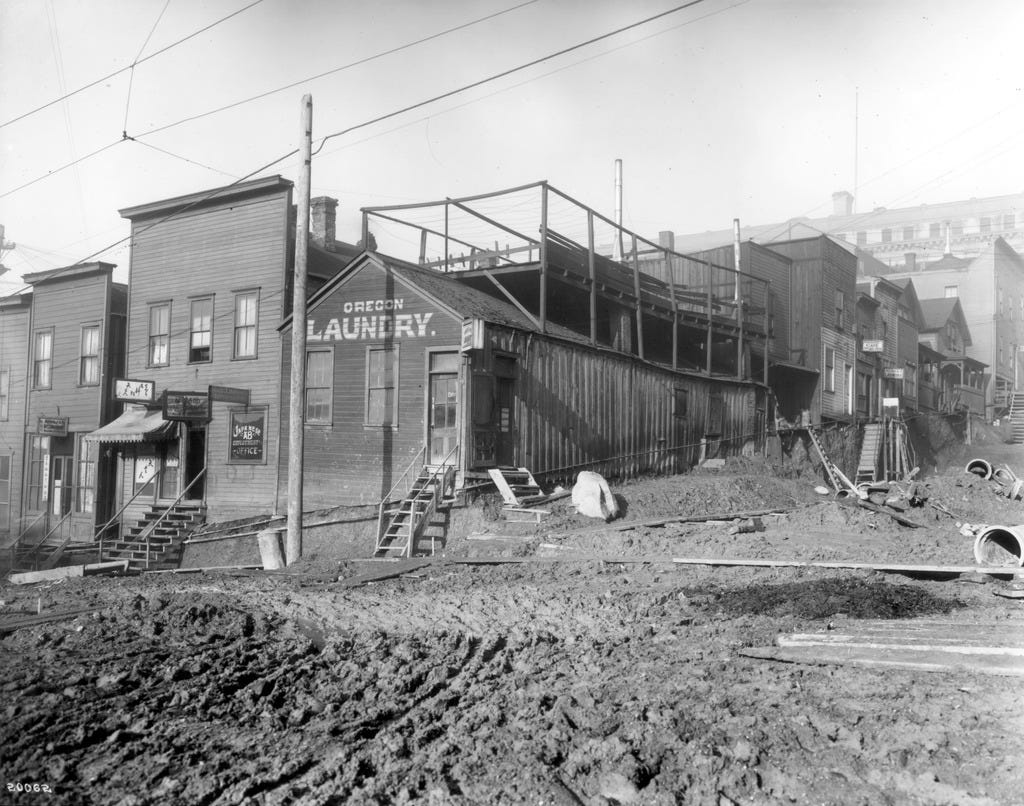
Part of Seattle’s Nihonmachi (Japantown), c. 1905
Credit: Densho Digital Repository
With help from Kikuzō, Sōtarō found work as a houseboy: scrubbing floors, polishing silver, serving at table. The job reflected his youth and his superior education. Most Japanese immigrants went to work in the canneries or on the railways, where they earned as much as $40 a month – an enormous wage compared to the four to five dollars a month earned by skilled factory workers in Japanese cities at the time. By contrast, a young man hired as a house servant would have received only $20 a month; but he was provided with housing in the basement or attic of his employer’s home, as well as a suit of western clothes and full board. His work also gave him an opportunity to learn English. Many of the better-educated young men arriving in Seattle had plans to enroll in study programs. Sōtarō himself said later that he came to the United States “to study.” Their jobs as house servants allowed them to dress respectably, learn some English, and, if they found the right opportunity, attend night school.
In these wealthy homes, Sōtarō glimpsed a world of wallpapered parlors, carpets, and clocks that chimed on the hour. He also learned more about his disadvantages as a Japanese immigrant. House servants were generally treated by their masters and mistresses with casual condescension at best, contempt at worst. Sōtarō had to learn to smile no matter how he was treated, to perform his tasks with tireless energy, to accept all tasks no matter how menial or illogical, to work from dawn till late in the evening, and to retreat to his tiny attic room for a few hasty hours each night. As an Asian immigrant, even in his Western suit, he could expect abuse on the streets. Dating a white girl – let alone marrying one – was unthinkable. Anti-Asian sentiment was running high in the United States. Chinese immigration had already been halted by the Chinese Exclusion Act of 1882, but a treaty signed in 1895 guaranteed Japanese citizens free entry to the United States, and equal rights with American citizens under US law – though they were barred from citizenship by the Naturalization Act of 1870. The 1895 treaty spurred a wave of emigration to the western US, and by the time of Sōtarō’s arrival a powerful movement had arisen to impose the same restrictions on Japanese immigrants as on Chinese. In 1907, the Japanese government agreed to stop the emigration of laborers to the US, and in subsequent years, state and federal laws places increasing restrictions on the rights of Japanese in Japan, culminating in the Immigration Act of 1924, which placed severe restrictions on the entry of Japanese to the US. Sōtarō was one of the last to be allowed in. But he was to be “forever foreign”, with no hope of full assimilation into American society.
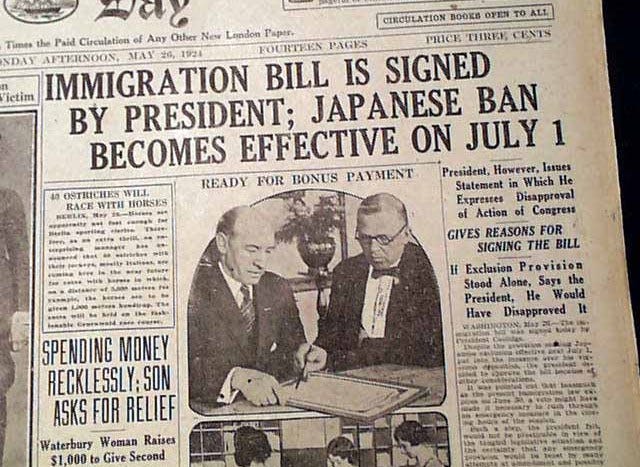
A newspaper reporting on the Immigration Act of May 24, 1924
Credit: We're History
Sōtarō made the most of his circumstances. He saved every penny he could, and he studied hard to learn English. His workplace was his classroom. Many immigrants remained trapped in menial jobs for years, invisible servants in other people’s houses. That was never Sōtarō’s intention. The ambitious youth was determined to make his own way as an independent businessman.
After two years, still only eighteen years old, Sōtarō launched his first business enterprise. Leaving his job in Seattle, he relocated to Monroe, a logging and farming community thirty miles north of Seattle. The details are unclear, but somehow Sōtarō had found an opportunity to become the manager of a small hotel and hotel and café, the Commercial Hotel. Although small, Monroe was a growing town. The Great Northern Railway, completed in 1890, had a station there. That in turn had attracted new enterprises. In 1908, the Carnation company opened a dairy processing plant in Monroe, to make canned condensed milk. The Washington State Reformatory had also recently opened there. Perhaps Sōtarō was counting on the future growth of the region. But he was young and inexperienced, and he may have underestimated the extent of anti-Asian prejudice: Monroe was a very white community. And there was competition. The Pearsall was the largest hotel in town, and there were at least two or three others. Within a few months, Sōtarō’s hotel had gone out of business.
Returning to Seattle, Sōtarō found work as a cook, a position which required none of Sōtarō’s education or skills, but which typically paid around $35 a month. Once again, he had no intention of becoming trapped in a dead-end job. Saving every penny he could, Sōtarō planned for his next move.
This story is part of a series called “Japantown Stories”, about the adventurous spirits who made the journey from Japan to America around the turn of the twentieth century. If you like what you’re reading and want to see more of this work, please subscribe!
For Part 3:
