

The American Dream (Part 1)
The story of “Harry” Kawabe, a penniless immigrant who beat the odds.

This is a million times-told story. A sixteen-year-old boy, facing limited prospects at home, leaves in search of a better life. He makes his way to America, land of golden dreams and harsh realities. He experiences economic exploitation, crushing loneliness, hard labor, vicious racism, and a social and legal system designed to prevent him from prospering. Yet prosper he does, beyond even his wildest dreams.
In this story, our hero comes from the village of Umegahara on the shores of Lake Biwa, in western Japan. His name is Sōtarō, and the year is 1906.
It was a steamy August afternoon. On the platform of Maihara station, the express train from Kyoto to Tokyo was pulling in amidst a cloud of smoke and steam. A small crowd had gathered under the shade of the awning. They were there to say goodbye to Sōtarō, who was about to set off on the biggest adventure of his life. Sōtarō bowed his final goodbyes, made sure the porters were taking care of his trunk, and climbed through the open door into the smoke-filled third-class coach. Having found an empty seat, he stowed his suitcase and squeezed through to the window to wave his goodbyes one last time. As he leaned out of the open window, he watched the town he had lived in all his life recede to the horizon.
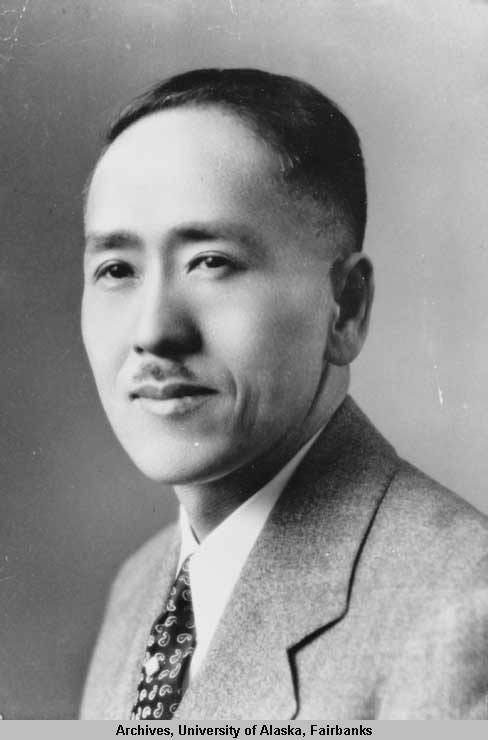
“Harry” Sōtarō Kawabe, c. 1941
Credit: University of Alaska, Fairbanks Archive
Crammed onto his hard wooden bench for the sixteen-hour journey to the port of Yokohama, Sōtarō’s mind roamed across the past and the future. A year ago, he had graduated from middle school. He had been lucky to get an education beyond the standard four years of elementary school. It was a privilege reserved for those families with enough resources to feed an extra mouth, pay the school fees, and to lose a farmhand while their son was in school. He had his parents’ relative wealth as small-scale landowners to thank for it.
But his prospects after graduation were not good. Japan had just ended an expensive and draining war with Russia. The government’s heavy borrowing had pushed up taxes and tightened credit, squeezing rural households. For young men without capital or further education, factory jobs were uncertain and wages low. His family was comfortably off, but Sōtarō was the fourth son. Even in good times, rural Japanese families could not support multiple children. Usually, only the oldest son stayed in the family home. The daughters were married off or went to find jobs in the cities, and younger sons like Sōtarō had to make their own way as best they could.
Since graduating, Sōtarō had been working on neighboring farms, earning a little extra money. He had managed to save up about 120 Yen, or $60. Then he had gone to ask his father for a little extra help, as he told his parents of his fondest dream: to emigrate to America and make his fortune.
Sōtarō shared this dream with thousands of farm boys from all over Japan. By 1905, tens of thousands had already emigrated to work on the sugar and pineapple plantations of Hawaii, and a smaller number, perhaps 30,000, to the rich farmland of California’s Central Valley and the west coast cities of San Francisco, Seattle, and Vancouver. Now, the postwar economic downturn was triggering a fresh wave of emigration, as young men throughout Japan sought opportunity in Hawaii and the United States.
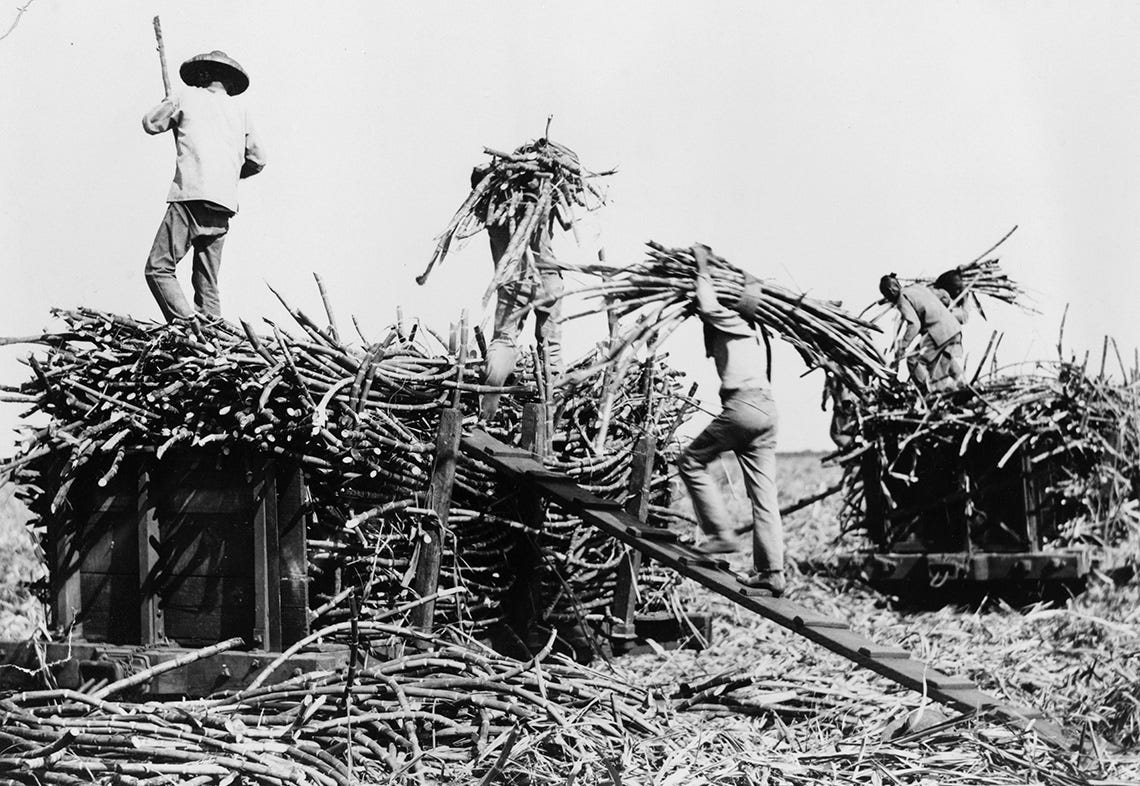
Japanese sugarcane laborers in Hawaii, c. 1917
Credit: Library of Congress
But getting to the US was not cheap. Even a third-class berth on a transpacific steamer cost from fifty to seventy dollars – a fortune for most rural families. It took all of Sōtarō’s savings and a little extra help from his family before he was ready for this day. He thought of his parents, brothers and sisters, cousins, and school friends from Umegahara – the only people and the only place he had known his entire life. Who knew when, or if, he would see them again?
After the long, hot, crowded journey up the spine of Japan, the train eventually entered a smokey landscape of suburban houses and factory chimneys, before chugging into Yokohama station, one of the last stops before its Tokyo terminus. Holding onto his suitcase, Sōtarō found a porter to help him carry his trunk to the rickshaw stand, where he hired a puller to carry the trunk to the docks. Harry walked alongside the rickshaw through the port town’s crowded waterfront streets.
His ship, the NYK line’s Shinano-maru, was already waiting at one of the huge berths, and, after a night in a crowded dormitory, Sōtarō presented himself at the boarding station early the next morning. A clerk from the shipping office checked his documents, Sōtarō was sent to a small hut on the dock for a cursory medical check, then he was pointed up the gangplank and, after another ticket check, herded down several flights of steep iron stairs into the third-class hold. He found himself in a large cabin for single men, lined with iron bunks. The passengers, who were almost all young men, were milling about claiming their berths. Next door was a smoking room lined with metal tables. Young men were eating the last of the meals their family members had packed for them before saying goodbye. Some were playing card games, others writing letters under the dim electric light bulbs. The cabin’s portholes were open, but the quarters were stiflingly hot.
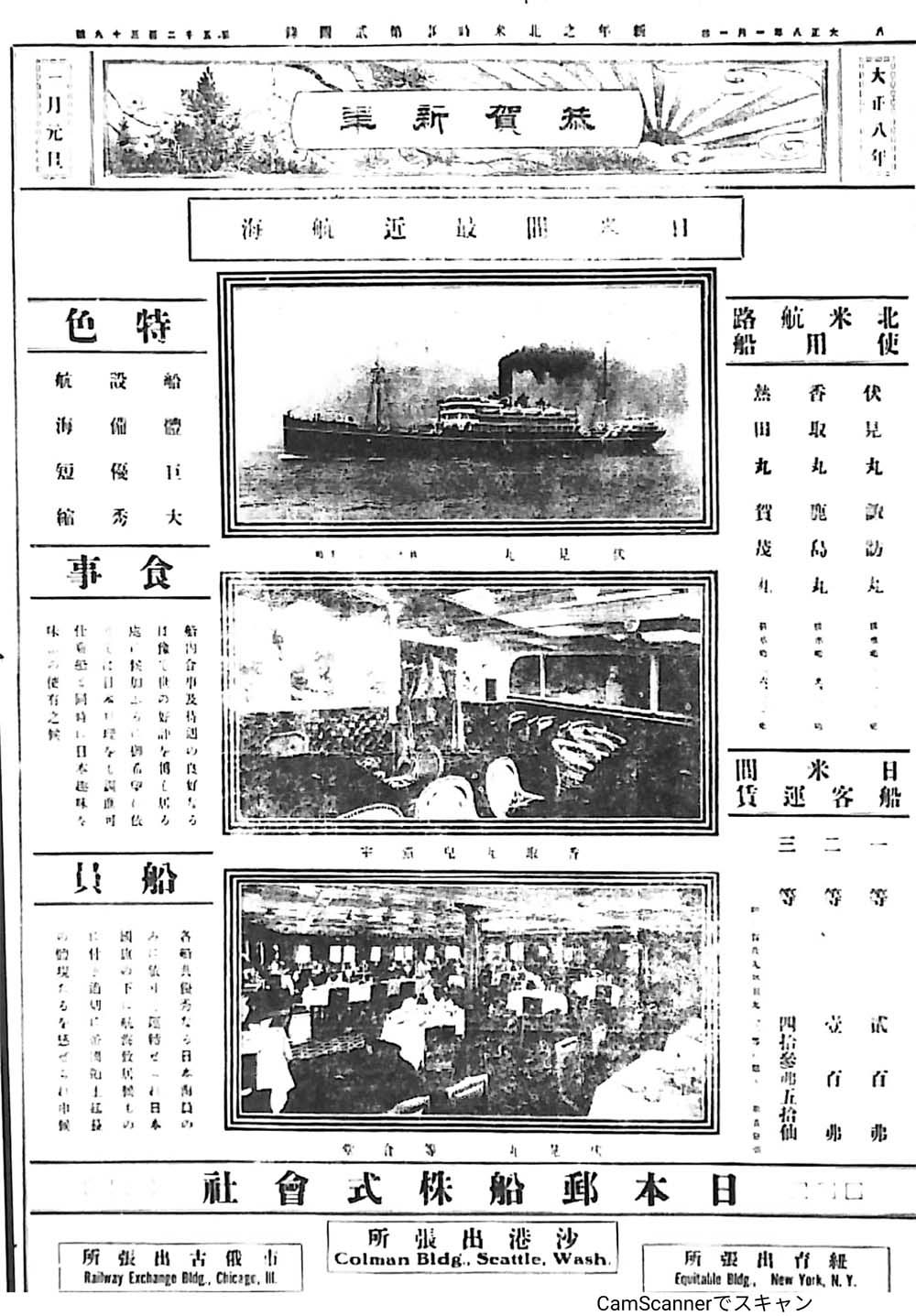
Advertisement for Nippon Yusen Kabushiki Kaisha (NYK Shipping), Jan. 1, 1919
Credit: Discover Nikkei
The journey to Seattle took eighteen days, with a refueling stop in Honolulu. The third-class passengers were forced to stay below deck for hours at a time, only being allowed up when weather conditions and deck space permitted. Their quarters stank of rotting food, human bodies, coal smoke, and vomit, and they were noisy with chatter in the varied dialects of villages throughout Japan. Meals, served below decks and often eaten at the passengers’ bunks or on the floor, were austere: rice, miso soup, pickles, and dried fish. Privacy was nonexistent. But spirits were high nonetheless. The passengers were embarking on the adventure of a lifetime, and many shared Sōtarō’s dream of finding riches in America. Everything was new and exciting: the ship, the exotic first-class passengers that they occasionally glimpsed from the lower deck, the balmy languor of Honolulu, and, finally, the green, mountainous islands of the coast of North America.
This story is part of a series called “Japantown Stories”, about the adventurous spirits who made the journey from Japan to America around the turn of the twentieth century. If you like what you’re reading and want to see more of this work, please subscribe!
For Part 2:

This makes the middle seat in economy class on United Airlines sound luxurious. I suppose the story won't continue with the Japanese version of Jack Dawson meeting his Japanese version of Rose DeWitt Bukater on deck, will it?